Insider Brief
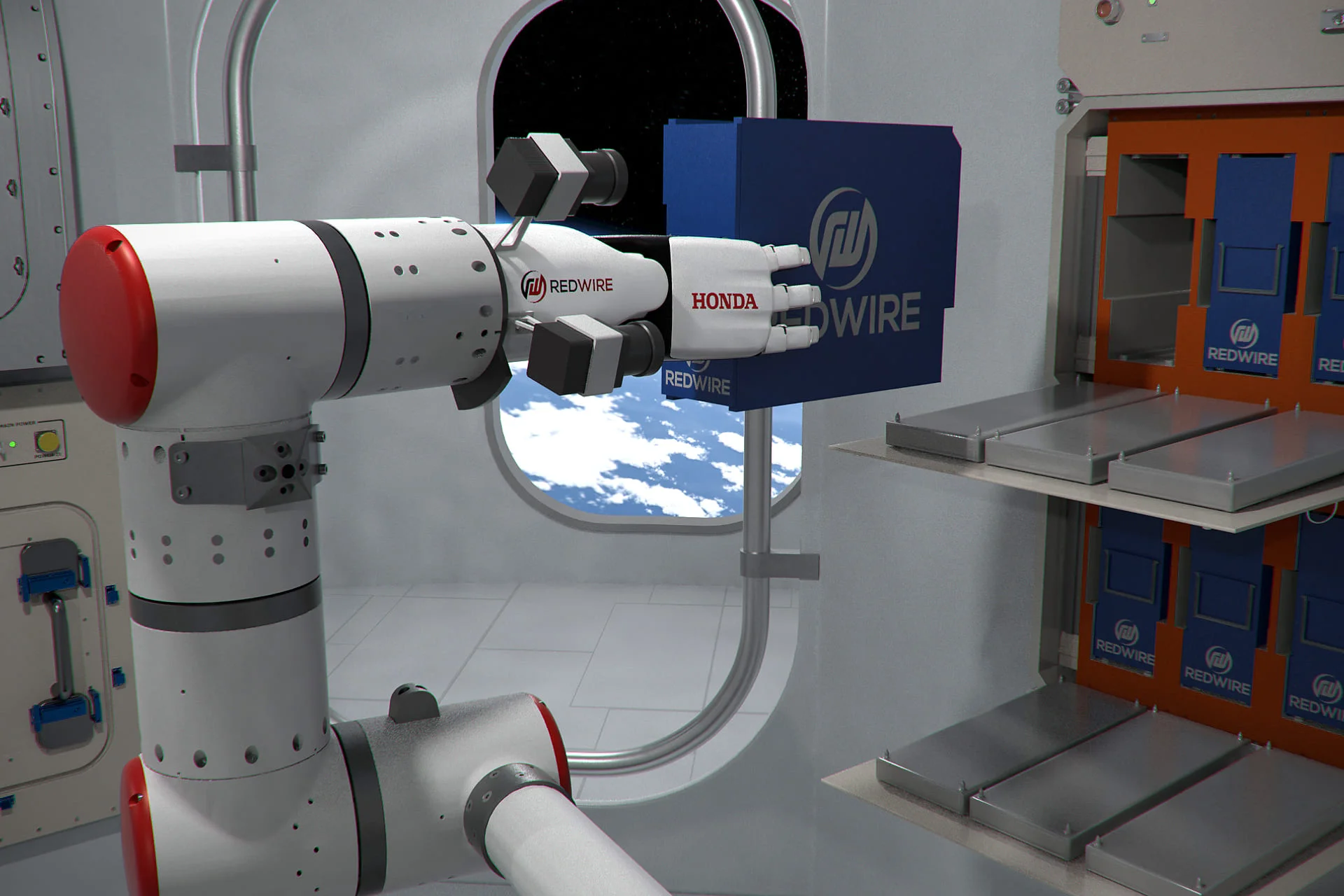
- Honda’s U.S.-based space development team is working with Redwire on a robotic system for future commercial space stations that would combine Honda’s multi-fingered hand with Redwire’s STAARK arm to automate research and laboratory tasks.
- The system is being explored for work including sample handling, material transfers and equipment operation, with Honda providing dexterous manipulation and Redwire providing reach and positioning.
- Honda and Redwire plan to discuss potential applications with commercial station developers and industry partners at the International Astronautical Congress in Antalya, Türkiye, Oct. 5-9.
Honda’s U.S.-based space development team is working with Redwire to explore a robotic system for future commercial space stations that could automate experiment handling and other laboratory tasks while reducing demands on astronaut time.
According to Honda, the concept would combine Honda’s multi-fingered robotic hand with Redwire’s STAARK robotic arm and experiment-locker technology for research operations in low Earth orbit.
Honda noted the work comes as NASA prepares to transition from the International Space Station to commercially operated stations that are expected to use smaller crews and shorter astronaut stays. That could increase the need for automation to handle routine research and station-support work.
“Honda space initiatives, including our robotic hand, are focused on enabling practical operations in orbit,” said chief engineer of American Honda’s space development division Tom Sladek. “Working with Redwire, Honda is evaluating how robotics with human-like dexterity could support research activities aboard the next generation of commercial space stations, helping crews accomplish more in an environment with fewer personnel while improving operational efficiency.”
Redwire currently has eight facilities aboard the International Space Station and develops hardware for science and technology experiments, along with robotics and in-space manufacturing technologies.
“Commercial space stations will transform Low-Earth orbit, and advanced space robotics are critical in enabling technologies that will help us unlock the value for our customers,” added Shawn Buckley, executive vice president and chief operating officer at Redwire Space.
Combining Dexterity and Reach to Automate Research Work
Many experiments conducted in orbit require astronauts to retrieve samples, transfer materials, operate laboratory equipment and move items between workstations. Honda and Redwire are exploring whether robotics could take on some of those activities.
Honda’s robotic hand combines actively controlled joints with force and tactile sensors across the fingertips and palm. The company said the design allows the hand to detect contact and perform delicate manipulation required for laboratory work. Honda has also subjected the hand to durability testing under different fingertip loads as it evaluates the technology for space applications.
Redwire’s STAARK system would provide the reach and positioning portion of the proposed setup. The modular robotic arm is designed for on-orbit applications and has demonstrated autonomous tracking and grasping of moving objects, according to the company.
Combining the technologies could allow the STAARK arm to position Honda’s hand around a station while the hand performs more precise manipulation. Honda said the system could automate portions of research ranging from sample handling and material transfers to equipment operation.
Honda and Redwire plan to meet with commercial station developers and prospective partners at the International Astronautical Congress in Antalya, Türkiye, Oct. 5-9 to discuss potential applications for the combined system.