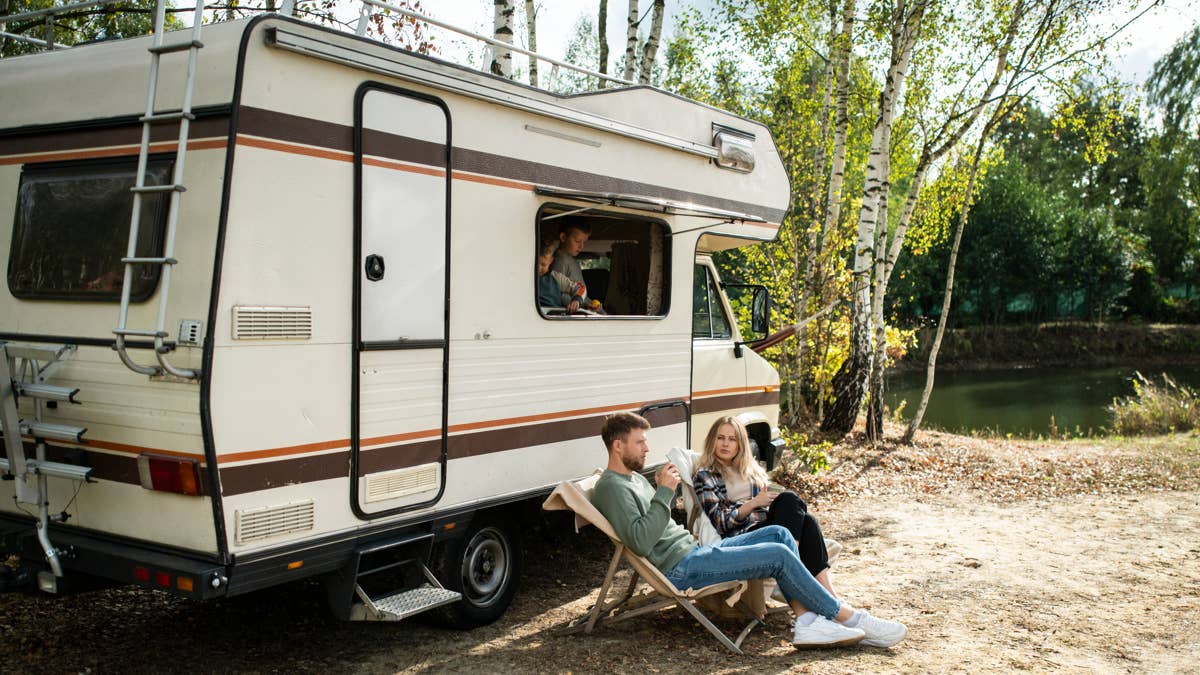
A shiny new RV still offers the same package.
A packed cooler, an open road, and a vacation sidestepping airport lines. But the price tag now comes with a bill that complicates things in a big way.
That pressure is already showing up on dealership floors. Americans are buying far fewer new recreational vehicles, while used models are holding up somewhat better.
The shift is forcing businesses to rethink how they attract customers who still want to travel but have less room in their budgets for big purchases.
That also helps explain a surprising move from Wells Fargo, one that says plenty about what RV buyers can afford today.
According to TheFly, on Nov. 9, the banking giant backed Camping World (CWH), America’s largest RV dealer, while turning bearish on premium RV manufacturer Winnebago (WGO).
The contrast in the calls points to a bigger message for RV buyers: Affordability is reshaping the market, and even established brands aren’t immune.
Wells Fargo’s opposite RV calls reveal a growing divide among buyers
Wells Fargo is betting that Camping World is better positioned than Winnebago to serve increasingly price-conscious RV customers.
On Nov. 9, analyst Anthony Bonadio initiated Camping World stock with an Overweight rating and a $6 price target, while reinstating Winnebago Industries at Underweight with a $27 target.
The Camping World target represented nearly 31% upside from the $4.59 share price cited when the call was reported. At the same time, Winnebago’s target pointed to approximately 14% downside from its reference price.
More Retail:
- Struggling home goods chain closing more stores
- Verizon makes changes to be more like T-Mobile used to be
- Home Depot drops generous offers as customers grow harder to win
The diverging views are best explained by looking at the companies’ business models.
Camping World holds more than 20% of the new-RV dealership market, with a major used-vehicle operation along with added sales from financing, insurance, service, and Good Sam memberships, as reported by RVNews.
Wells Fargo also touted the retailer’s positioning for value-seeking customers, management improvements, and debt-reduction opportunities, as well as its ability to acquire smaller dealerships.
On the flip side, Winnebago faces a significant challenge. Roughly 85% of its revenue comes from RVs, and Wells Fargo believes its premium positioning leaves it exposed as customers seek cheaper alternatives.
The bank noted that Winnebago’s revenue fell 45% from its fiscal 2022 peak, while earnings before interest and taxes have plunged 88%.
Americans are pulling back on new RVs, and the numbers show why
Camping World’s latest quarterly earnings result show that customers are getting a lot more selective, particularly when it comes to choosing between new and used vehicles.
In Q3 2026, the company underscored a marked difference in unit sales:
- New RV sales: Down 25.4% to 15,126 units
- Used RV sales: Down 8.1% to 17,176 units
- Average new-vehicle selling price: Up 11.7%
- Average used-vehicle selling price: Down 4.2%
Financing makes the affordability issue even more problematic.
LendingTree put the average new-RV loan rate at about 7.60%. At that rate, financing $40,000 over 10 years would cost nearly $477 monthly, excluding insurance, maintenance, fuel, taxes, and campground fees.
That is nearly $5,724 a year in loan payments alone, a massive commitment for households already juggling mortgages, groceries, and other expenses.
Industry figures underscore that pressure.
The RV Industry Association reported that wholesale shipments tanked 13.7% during the first nine months of 2026. Separately, new-RV retail registrations dropped 15.9% through August, based on data cited in Camping World’s SEC filing.
“Persistent inflation, elevated interest rates, higher fuel prices, and broader economic and geopolitical uncertainty have weighed on consumer confidence and purchasing power,” said RV Industry Association CEO Craig Kirby.
The worrying bit is that many Americans are delaying purchases altogether, raising a harder question for the retailer Wells Fargo favors: Can a value-focused strategy overcome an industrywide sales slump?
Wells Fargo sees an RV winner, but a 2027 recovery remains uncertain
Camping World is looking to cut costs as it waits for RV demand to recover. Management targets more than $150 million in annualized savings by 2028, but its finances remain strained.
The retailer reported a $320.1 million Q3 net loss, along with a $286.7 million goodwill impairment and $1.42 billion in long-term debt. Adjusted EBITDA was $36 million, with full-year results expected below earlier guidance of $230 million to $270 million.
The industry offers little relief.
The RV Industry Association forecast 290,000 wholesale shipments in 2026, down 15.3%, and 285,000 in 2027. Camping World needs to improve its operations, even if customers remain cautious.
At this point, Wells Fargo prefers Camping World’s value-focused business, but both businesses face essentially the same affordability problem.
Americans still want RV vacations, yet borrowing and ownership costs make those purchases a lot harder to justify.