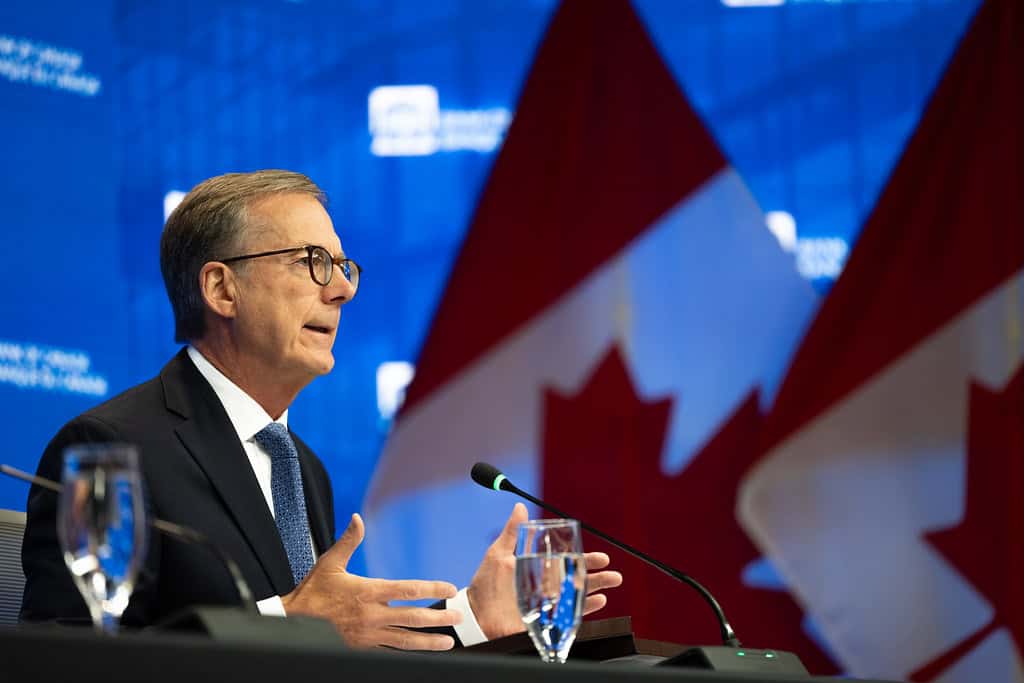
The Bank of Canada kept its policy rate steady at 2.25% after lowering it by 25 basis points on October 29, 2025. After a year-long holding period, it raised the benchmark by a quarter-point to 2.5%. The central bank did not cut interest rates when inflation fell below 2% in February 2026, nor did it hike them in May or July when headline inflation was 3% or more.
After looking through the global energy shock of the past few months, it was time to tighten a little. Canada’s headline inflation hit 3.1% in September and could spiral higher as energy prices surge. BOC Governor Tim Macklem said the upward adjustment won’t restrain economic growth but will help prevent broader, generalized inflation. However, could more rate hikes be coming?
Investors on edge
During the post-meeting press conference on October 28, 2026, Macklem acknowledged that further rate increases might be necessary if inflation remains persistent. He said policymakers are very mindful of the uncertainties but will proceed carefully. “There is no predetermined path,” added Macklem.
The prospect of a prolonged rate tightening cycle will keep investors on edge. Any rate hike, especially in a higher-for-longer environment, directly affects the stock market and investors. Borrowing costs will increase while corporate profits will thin. The day after digesting the news, the TSX closed lower.
TSX performance
The S&P/TSX Composite Index has demonstrated remarkable resilience over the past year despite persistent macro uncertainty and war anxiety. Canadian domestic stocks are collectively up 14.3% year-to-date. The recent rate hike creates a headwind for rate-sensitive sectors.
Energy (+61.6%), financials (+22.7%), and utilities (+11.8%) are the top-performing sectors heading into the last two months of the year. Basic materials (+0.15%), notably gold stocks, might regain strength as investors seek safe havens to hedge against inflation. Some investors might also rotate out of riskier stocks into lower-risk investments such as government investment certificates (GICs).
Strong buy candidate: Earn in two ways
Analysts have raised their price target on Suncor Energy (TSX: SU), one of the select energy stocks that benefits greatly from the oil price shocks. The oil bellwether could outperform the market over the next 12 months as it continues to generate significant cash flow across different market conditions.
The $127 billion integrated energy company delivered a record quarterly free funds flow (FFO) per share of $3.38 in Q2 2026. In the three months ending June 30, 2026, FFO climbed 84.7% year-over-year to nearly $4 billion. Net earnings also rose 229% to $3.7 billion from Q2 2025, while net debt fell 41.6% to $4.5 billion.
Suncor President and CEO Rich Kruger said, “The quarter was led by the exemplary performance of our downstream business, delivering record quarterly adjusted funds from operations and record second quarter refining throughput and refined product sales.”
Performance-wise, SU investors enjoy a market-crushing 82% year-to-date gain versus the energy sector’s plus-61.6%. Its total return over the last three years is plus-171.3%, representing a 39.5% compound annual growth rate (CAGR). If you invest today, the share price is $108.65, along with a safe dividend yield of 2.21% (31.6% payout ratio). Investors earn from Suncor Energy in two ways.
Prepare for the next rate hike
The Bank of Canada is determined to contain the energy-fueled inflation. While Governor Macklem made it clear the central bank remains flexible, Canadian investors should prepare for another potential round of rate hikes, not an easing cycle.